
Uniqueness ~ A Seeking on the Edge
By Susanne Martman.
In a recent Continuum gathering we explored the theme of uniqueness. Several of the questions that arose have stayed with me. How do I express my uniqueness within the larger context of culture? How do I find time in my life to develop this awareness of myself? Can I recognize my own uniqueness in relation to others?
This morning I received a text from my daughter, “I adore floating candles. So enchanting.”
Right away I was with her picturing the dancing flames, fire and water together…the enchantment of it all. In this brief message I felt her presence, her characteristic way of responding to life, from the heart with clarity and simplicity. I contemplated the art of meaningful communication and how its essence seems to rise froma felt sense of connection with our uniqueness.
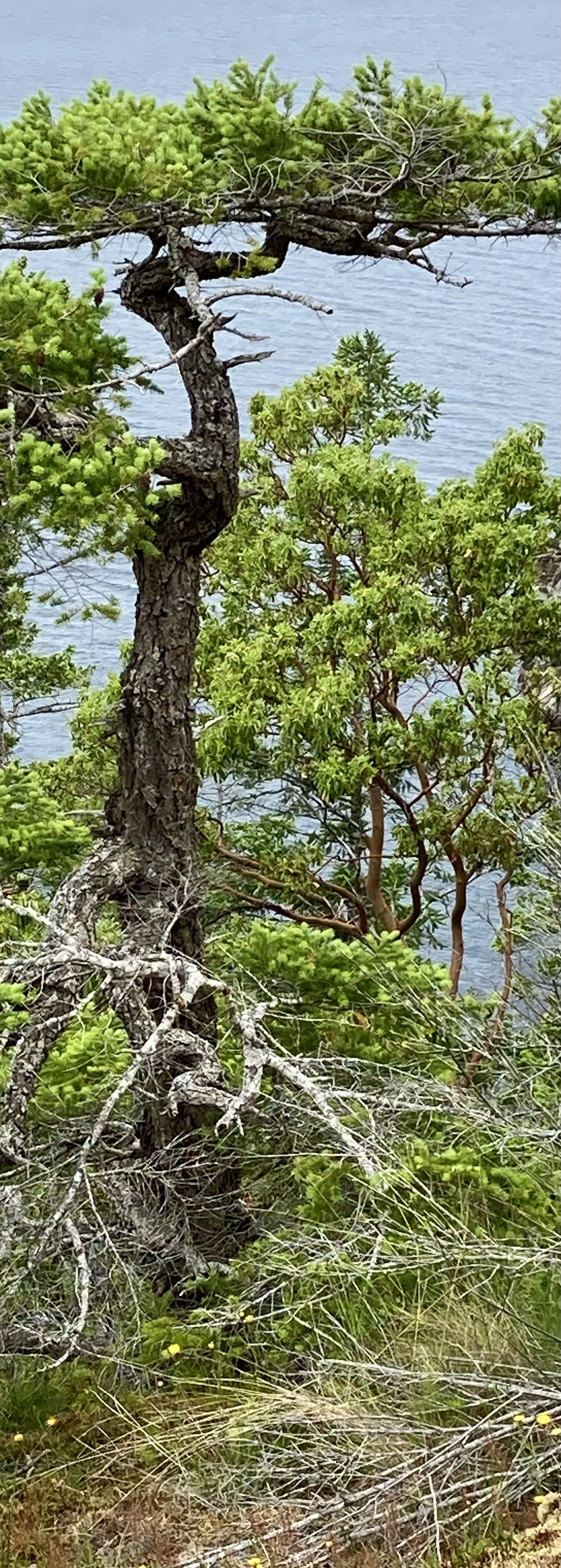
Next, my attention went to the natural world of my immediate surroundings. Looking out the kitchen window, I saw framed a low-hanging branch of a cedar tree, a single graceful bough stirred by the breeze. My cat lay curled on the chair beside me. Both were unquestionably and unabashedly expressing their uniqueness – the only way of being they know – with every movement and in every moment. My attention shifted to their adaptations to the environment. I sensed a steadfast vitality in approaching limits – the cedar tree gripping the edge of an eroding bank, seeking stability where it could be found – and my cat, abandoned as a kitten and left to fend for himself. Both flourish and express their wild uniqueness as part of the larger web of life.
What joy to behold any life form engaged in the seeking process, learning its way into full expression, like a “concentrate” in which uniqueness becomes visible. Many times this uniqueness can seem “diluted,” and hard to trace in a sea of sameness – yet without the sameness there would be no distinction giving rise to uniqueness; one cannot exist without the other.
Recently I watched a video clip of a microscopic organism going about the business of living. Gradually, things began to change…movements slowed, metabolic processes stopped, pieces of the ciliate began to tear away…the organism was dying, becoming part of its surroundings and returning to equilibrium. To be alive, to exist, is to creatively resist returning to sameness and blending with the surrounding environment.
From a human perspective, I ask…What stands in the way of expressing uniqueness?
Different from innate expressions, human uniqueness emerges through day-to-day participation with our lived experiences. Being present within at the silent level offers an embodied connection to our uniqueness – as we get in touch with our values, the soma, or “the body,” makes meaning and acts as a guide in uncovering a sense of purpose. Emilie Conrad, in describing her experiences with Continuum, wrote, “I got to know my silence in a way that was friendly.”
If we consider the etymology of the word unique, we find its Latin origin unus, meaning one, single, only. This “one of a kind” marvel finds expression through the uniqueness of the soma. While all humans have common biological responses to life, through the affect and drive system, each of us is a unique perspective. There is no one else in the world who feels in just the way I feel, senses in just the way I sense and encounters life in just the way I do.
First order experiences refer to ways the organism responds internally to changes in the immediate environment through sensations relating to tension and release, steadily transforming a kaleidoscope of shifting meanings into higher level interpretations – the descriptions, interpretations and conclusions that we draw from what’s going on in the world around us. As each of us abstracts what the soma has deemed meaningful, our experiences are filtered through lenses of perception coloured by tints of our own making. Learning to accept our uniqueness as a fluid movement, rather than a fixed or static identity, keeps our “one of a kind” self ever growing and changing.
In a Continuum dive, we encounter what’s within – affects, feelings, and emotions, and their accompanying sensations – the undercurrents of our being and the lifeline to our uniqueness. Giving interested attention to the uncomfortable feelings of negative affects (fear, anger, distress, and especially shame) often begins a transformative process, inviting less integrated parts of ourselves to be once again integrated and available as pathways to living uniquely. To approach ourselves at this level calls for a great deal of interested vitality and an unwavering commitment to learning even when not understanding.
The process of cognition transforms the experiences of the organism into our uniquely human ways of “knowing,” involving both the commonly recognized intellect, along with the less commonly recognized thinking of the soma: impressions rising through memory, sensations and the subtle movements of muscular tensions and releases. Emerging from the silence of the soma and the symbolic realms of thought and language comes a new perspective – symbol informed by silence – thinking informed by feeling – an individual living “on the edge,” informed by uniqueness.
Often hidden is an implicit sense of learned shame around accepting our uniqueness. Learning into shame – becoming curious, questioning assumptions and exploring the underlying motivations of the affect system – in other words, finding movement within the resistance begins to soften the hardened shell of the self-image, opening to a vast and colourful kaleidoscope of possibilities. Cultivating an awareness of how we participate in this transformational process keeps us seeking, with each turn revealing unexpected and ever-changing wonders.
I see this as a seeking movement in a lifelong fluid learning process. As we dive into the mysterious waters of “the self,” we deepen our appreciation of each individual as a unique perspective with a thriving “one and only” contribution towards the whole.
“Uniqueness is always seeking. And seeking is on the edge. One of a kind moment – each moment is one of a kind at the learning level. That’s what learning fundamentally means, the uniqueness of experience.”
~ Gary David