A Handful of Apricots ~ Seasons in the Sun
By Susanne Martman
In a recent Continuum series our inquiry centered around the theme of what it means to imagine. We dialogued and then took our inquiries underwater into a dive and the realms of “the soma, ”where we imagine not only with the mind, but also through awareness of the muscular movements of subtle tensions and releases. As we surfaced, keeping the “wetness” of our embodied inquiry, we entered “dry land” of language and symbols. We pondered how it is that most of us have the ability and the desire to imagine beyond the limits of our current circumstances, yet often what has been imagined doesn’t come to fruition. The inquiry into imagination reminded me of Emilie Conrad’s insight into how visions live or die in the early stages of their unfolding. She writes,“If something is unthinkable within your frame of reference, the quiver of imagination will be aborted after the first stir.”
I had arrived!
Exhausted from a long flight, yet buoyed by the excitement of landing somewhere new, I made my way across Athens. Crowded onto a city bus, tightly packed passengers sat shoulder to shoulder as one stop melded into the next. Gradually, I felt my vigilance begin to soften – the unfamiliar letters of the Greek alphabet blurred one into another – and with a long, slow exhale, I rested in trust – my friend would be there to greet me when I reached the final stop. Eureka! There was Katerina, smiling and waving in welcome!
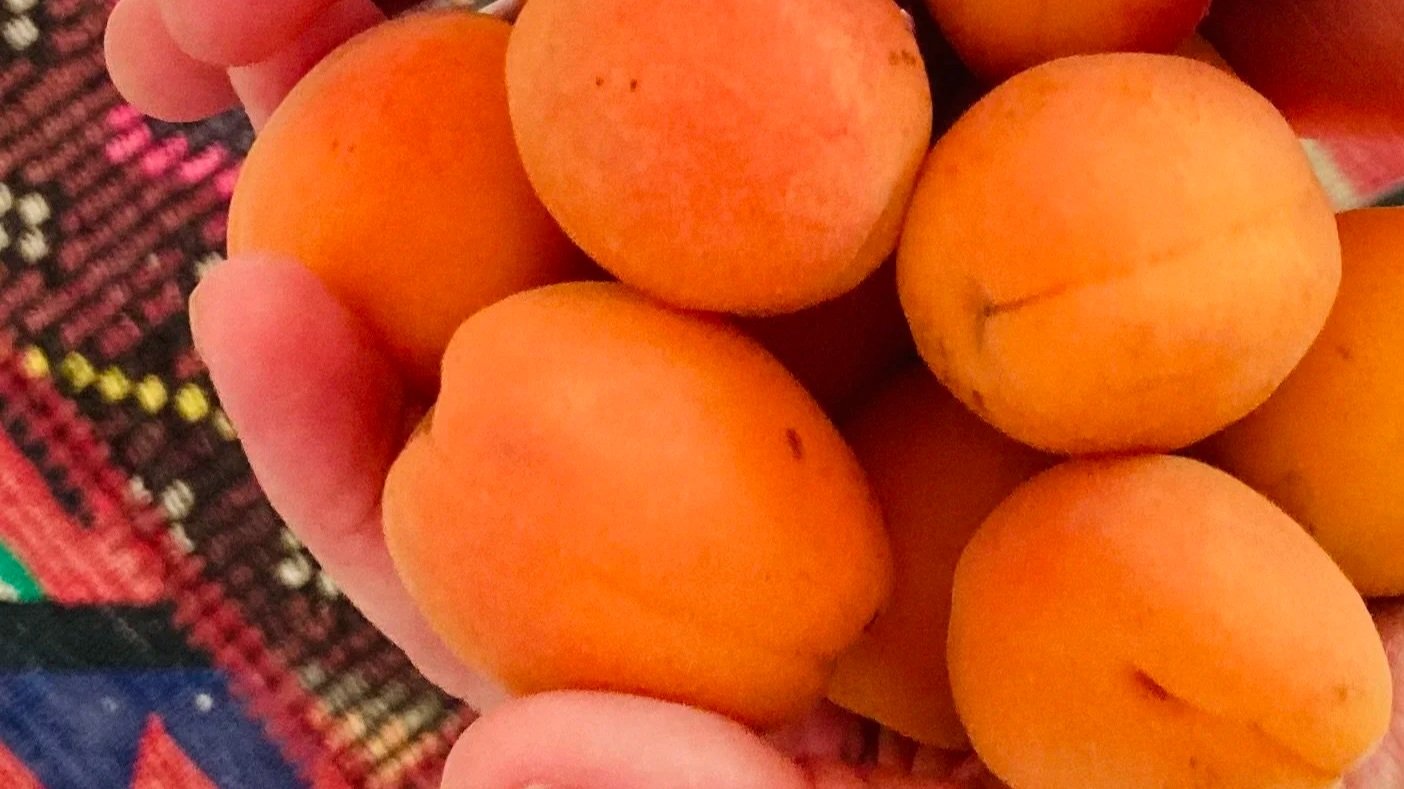
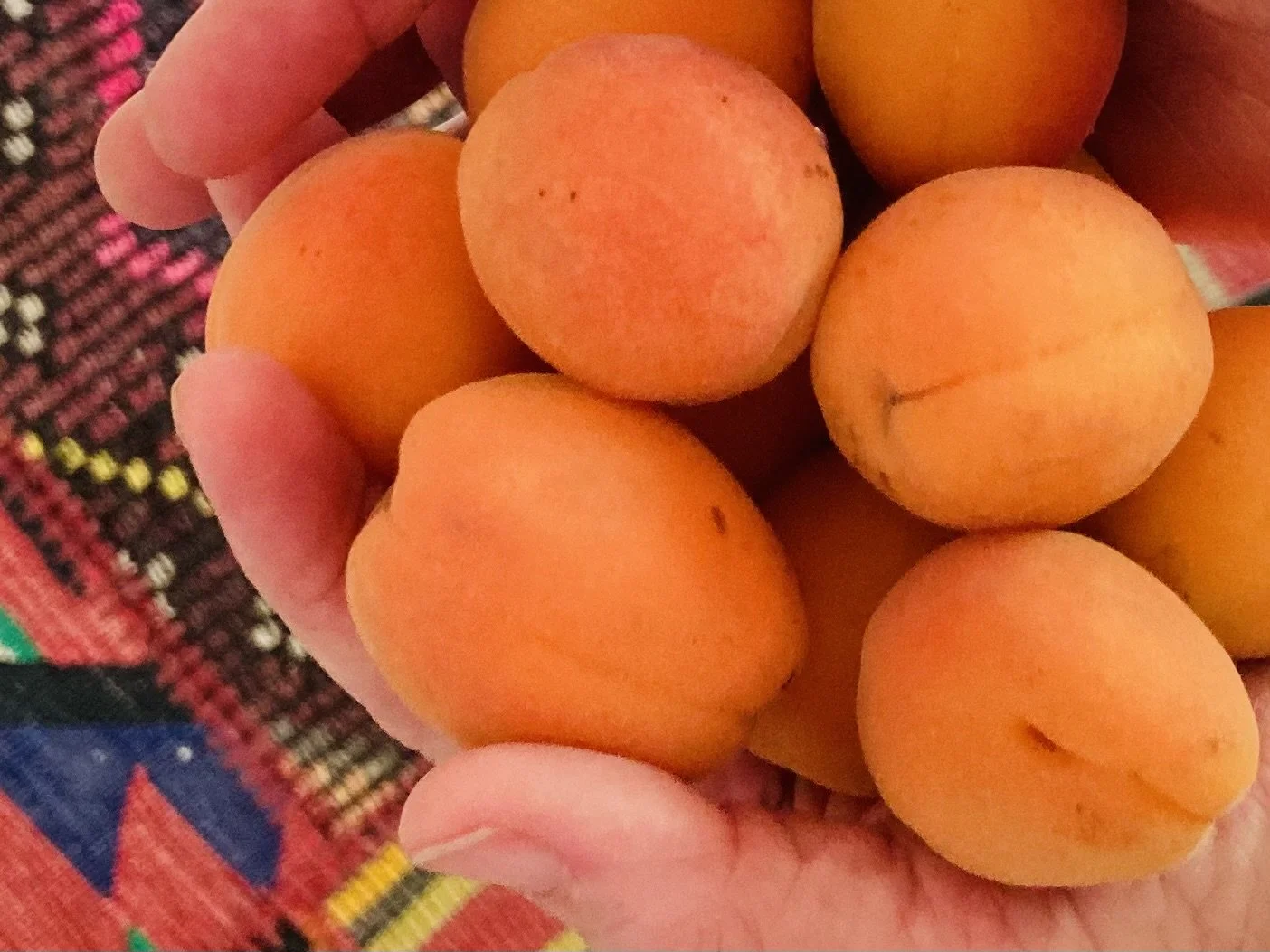
The next day we’d take a ferry to Tinos, a small island in the Cyclades Archipelago, and the following weeks would be spent immersed in the depths of a Continuum teacher training program. As we approached the entrance to Katerina’s home her father appeared, extending his cupped hands and offering me rounded mounds of velvety apricots, picked from a tree in the backyard and ripened crimson in the Aegean sun. I had never tasted fruit so good! Savoring the sweetness, I felt the warmth of this welcoming gesture of kindness spilling over and filling me from the inside out.
The apricot moment was more than food – it felt surplus – a gift of vitality. Often we think of surplus as relating to an abundant harvest, but let’s consider surplus in relation to need from a perspective that includes both physical/material abundance and an abundance of life force energy. In essence the same creative, generative impulse finds expression in different forms: an apricot, the human body, sentient creatures, the living Earth, or an infinite cosmos. A phrase, vital surplus, coined by L. L. Whyte, brings together the vital energy of life, vital (Latin – life-giving, essential) and surplus (Latin – sur/super (over) plus (more), excess beyond what is needed).
L.L. Whyte describes the vital surplus…”Not merely adaptive and life-preserving, but life-enhancing, formative, and sometimes creative. Inborn capacity to overcome whatever limits actions, coordination, and creativity. Humans suffer from surplus capacities beyond the needs of biological survival. . . cursed and blessed with a restlessness springing from still unrealized potentialities, far in excess of the degree of vitality that would be biologically appropriate or adaptively advantageous. It shapes new forms of behavior which may or may not prove advantageous, and it does this before the evolutionary process tests them out.”
Living our seasons in the sun…we are here, now…standing at the cusp of unknown directions for humanity and planet Earth. The vital surplus is our currency of exchange. How do we invest this restless energy seeking expression that rises in humanity, for better or worse, as it movesthrough us like a pulse, shaping our destiny? How can we, both individually and collectively, participate in this flow of creativity in ways that supports a future that is vital and life-sustaining?
How is it that our vital energies slip away and become a deficit rather than a surplus? Most often we deplete our reserves through our ways of thinking…how we talk to ourselves. J. Samuel Bois, author of “The Art of Awareness,” suggests a model of self-reflexivity, the ability to be aware of our own awareness. How unique we humans are as the only life form that can become consciously aware of our own thinking processes, and in doing so, offer the possibility of an emergence of something new while participating in its developing innovation.
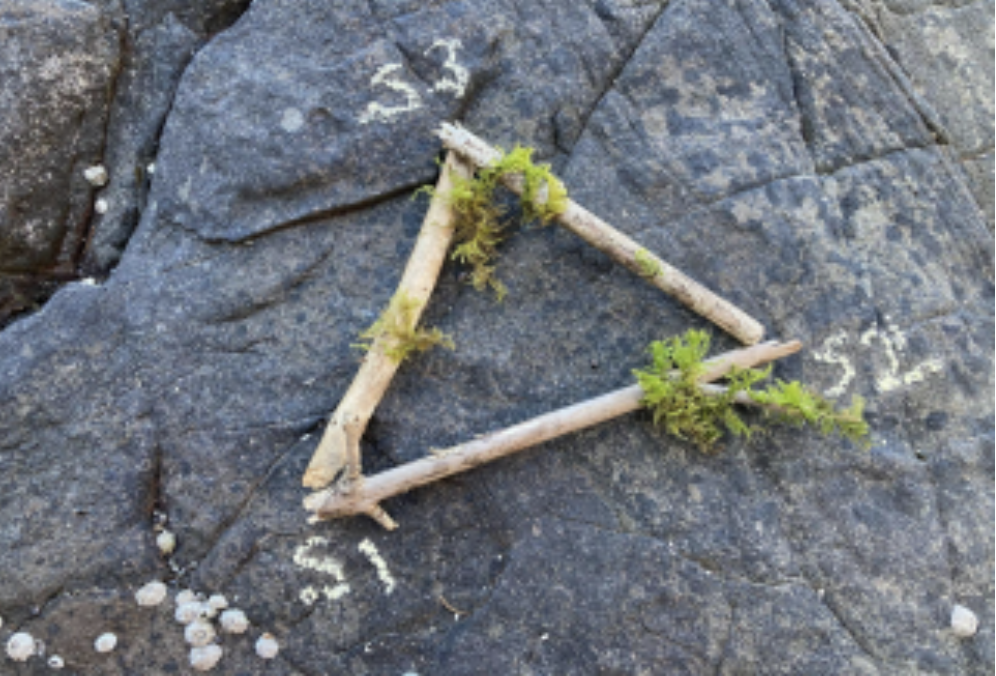
In the basic triangle of self-reflexiveness (being aware of how we’re aware) at the base is Self 1, immersed in life as a full participant, sensing, feeling, acting.
At the vertex is Self 2 observing self 1, offering a running commentary, rather like thought bubbles, often the harsh voice of an inner judge or critic,“You’re getting this all wrong!” Self 3 is positioned at the apex of the triangle, with an overarching perspective of the whole scene. This inner guide has an awareness of “the big picture.”
How are Self 1 and Self 2 interacting?… How’s the self-talk going?... Is it guided by evolved ways of thinking and supporting the movement of a life of learning? How are Self 1 and Self 2 evaluating the stimulus? Is a surplus being generated? How is the vital surplus being used? With the guidance of Self 3, Self 2 undergoes a transformation into a visionary.
Gradually, we can learn to befriend Self 2, inviting her to come alongside with her vision, “carrying the torch,” illuminating how the ways we talk to ourselves become opportunities for transformation. Instead of hearing a voice say,“What a mess you’re making – you’ll never get it right!” Self 2 may respond instead, “You’re doing okay…even if this doesn’t feel comfortable, you’re learning something new. ” As I accept the feelings in my body, approaching the tension of this dialogue with my interest and curiosity, the voice of a younger self is heard, recognized, and becomes less insistent. The tide turns, and slowly a transformation begins – subtle changes, a release, a flow of a different kind – a vital surplus arriving with the rising tide. The places where I had perceived a lack are touched by a softening and a sense of vital increase.
Like the apricots Katerina’s father offered – ripened by the sun, freely given —our surplus energies can nourish more than ourselves if we choose to share them.